Conceptual Blindspots
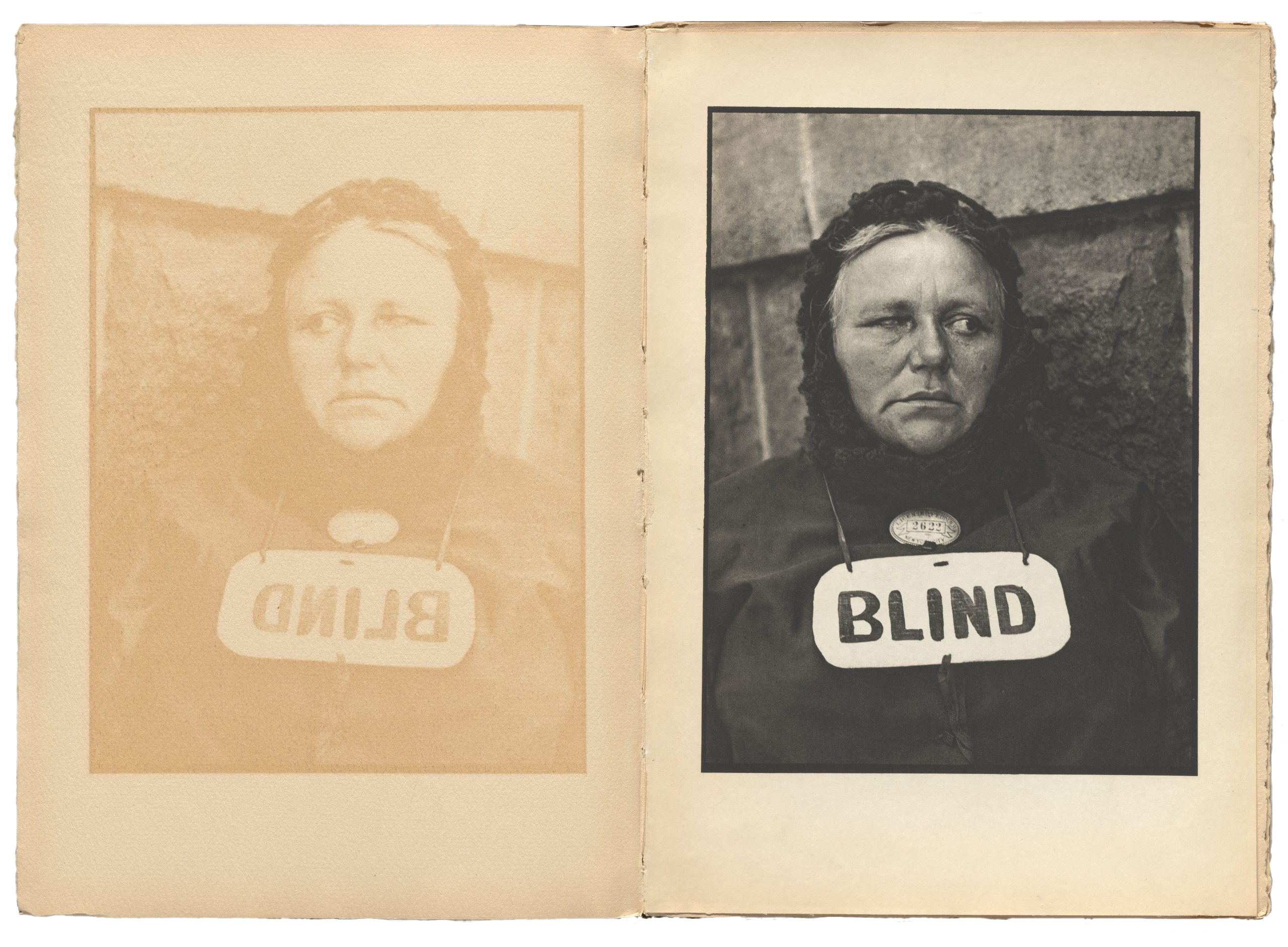
Blind - Paul Strand
Within our minds, there seem to be a set of conceptual primitives that we each possess that instruct our thinking and model-making of the world. These include, for example, concepts like space, time, numbers up to five, length, distinction between the continuous and the discrete, distinction between the general and particular of a thing, and so on. From these primitives, using analogies and metaphors, we derive all our conceptual understanding of the world. This is why analogies and metaphors are so central to language and thought – they allow us to construct brand new objects isomorphic to structures we’ve built from these primitives.
Now, imagine we were “missing” one of these primitives. Let’s say: the continuous and discrete. Had we no intuitive notion of the continuous, we would’ve been unable to construct foundational concepts such as infinity and subsequently all of calculus.
And what’s to say we aren’t missing any? What if there are simply truths of this universe that are unreachable by us as animals with a limited set of concepts at our disposal? If there can exist a world where we never developed the biological basis for concepts like infinity, what’s to say we aren’t currently in a world where we haven’t developed the biological basis for a concept that is massively more important for a full understanding of our world?
In mathematics, for example, to truly understand a thing intuitively means that it can be reduced down to “common” objects. (Typically, in the case of a sufficiently abstract object, it can be reduced to multiple different objects/relationships that share an underlying structure). And this is precisely what I mean – all new objects and relationships are understood in analogy with other objects and relationships. Thus, all conceptual understanding must be reducible to a set of axiomatic conceptual primitives. In fact, opening a dictionary to any word you’ll encounter its definition to be a distinction from, or relation to, another object of knowledge. For example:
- Chair
- a seat typically having four legs and a back for one person
- Leg
- a usually long narrow part (such as a pole or bar) serving as a support or prop
- Support
- to hold up or serve as a foundation or prop for
- Foundation
- an underlying base or support
But here we already have a recursion, let’s go back up to support and see if we can go any deeper via another route.
- Support
- to hold up or serve as a foundation or prop for
- Prop
- to support by placing against something
Not very far. And to give the Oxford dictionary some slack here, I don’t see how else you could go this deep into definitions without finding a recursion of some sort. The only other way to define something such as support would be in reference to what it isn’t, for example, something like “to refrain from collapsing” which, of course, would lead you back to a concept such as foundation.
Supposing all this is true, the first question to arise is concerning their origin; where do these concepts come from? It is clear that some primitive concepts are simply innate (such as justice, numbers up to five, general vs specific, etc) whereas new concepts of the same axiomatic caliber must be obtained via sense data (since, by definition, if a concept were derived from other concepts through reason, it wouldn’t be primitive in the first place).
Therefore, all “non-standard” primitives are, most plausibly, derived through some kind of experience. In other words, to escape this entangled mess of recursion, the only thing we can do to talk of certain objects is to leave the realm of the logos and simply point to the object as experienced in the sensory world. This is not all that surprising when you try to consider how fruitless it would be to explain redness to a man who was born blind. No amount of definitions, science of waves, or comparisons to heat will actually produce the understanding of redness in that man’s mind. At best, your language and reasoning about can only encircle the primitive indefinitely.